So I Married an Axe Murderer
This unit introduces what is commonly thought of as lightweight literature: Chinese ghost stories. Not until the twenteith century has ficiton of this nature even been considered a remotely respectable form of literature. That means that for centuries in China the writing of ghost stories and their enjoyment were almost entirely an unrespected, diversional activity, the indulgence of innocent children, bored youth and weery scholars. This however does not imply that they were not well crafted or culturally significant. Quite to the contrary. Ghost stories were an imaginative realm of the Chinese mind that gave vent to fears, desires, angsts and fantasies too often smothered in reality by taboos and propriety. They were often elegantly penned by the hand of learned literati. Furthermore, they contain much in the way of contemporary, social criticism and satire. Their role in the development of modern Chinese literature is significant (v.s. David Der-wei Wang, "Second Haunting").
Ghost stories in China are not strictly speaking horror stories, as understood in the Western sense. As a genre that grew out of taoist hagiographies (tales of magical sages), ancestor worship, folk religions and old stories, the tales involve the occult and fantastical but not necessarily the gory or terrifying. Their most acclaimed narrators in China come out of the Qing dynasty (1644-1912): Pu Songling and Zhi Yun.
Readings:
Pu Songling's Strange Tales (see ANGEL)
Zhi Yun's Sketches from a Cottage (see ANGEL)
Questions:
(1) What are unique about these ghost stories?
(2) What social issues do these tales seem to tackle?
(3) Locate some of the stories' stock characters. What is significant about their function?
Links:
*Tang Menglai's Preface
Secondary references:
* Chang, Chun-shu and Shelley Hsueh-lun Chang. Redefining History: Ghosts, Spritis, and Human Society in P'u Sung-ling's World, 1640-1715. Ann Arbor: U of Michigan P, 1998.
* Zeitlin, Judith T. Historian of the Strange: Pu Songlin and the Chinese Classical Tale. Stanford: Stanford UP, 1993.
*David Der-wei Wang and Shang Wei. Dynastic Crisis and Cultural Innovation. Cambridge: Harvard UP, 2005.
Sunday, May 31, 2009

Saturday, May 30, 2009
My Zen Teacher is Nuts!
My Zen Teacher is Nuts!
During the Tang dynasty, the foreign, import religion, Buddhism, became officially recognized and patronized by the imperial courts. Shen Xiu, the face of Buddhism for a time and founder of what is know historically as the Northern School of Zen, was strongly supported by aristocrats and nobility. In the shadow of of this public respendlence, however, another breed of Buddhism began to grow, and, very appropriately, from the unlikeliest of sources. Hui Neng, an illiterate fuel-wood peddler, and his energetic pupil Shen Hui began challenging the meaning and doctrines of prevailing Buddhist beliefs and practices by their emphasis on the religious significane of mundane, human experiences. According to this radical strand of thought, formal practices such as meditaiton and absolute quietude were unnescessary, even troublesome , auxiliaries to the perfectly adequate activities of everyday life in realizing one's Buddha-nature. The renowned sinologist Wing-tsit Chan summarizes the nature of Hui Neng and Shen Hui's poistion, named the Southern School (what would prevail as the as the orthodox Chan or Zen school), in the following way:
"Everything other than the cultivation of the mind, such as reading scriptures, making offerings to the Buddha, reciting His name, joining the monastic order, are regarded as unnescessary. The total effect is to minimize, if not to wipe out, the whole Buddhist organziation, creed, and literature and to reduce Buddhism to a concern with one's mind alone" (A Source Book 428)
Just how was this minimization brought about? The history is complex and the methods are sundry, but the prinicple is singular: to attach oneself to a master who will disabuse you of all attempts to attain Buddhahood. This seems perfectly counter-intuitive and counter-productive. It is. But because the Southern School believed that what was necessary for enlightenement was a stripping down of Buddhist practices, the methods tended to seem wildely irreligious and irreverent. This was meant to free the mind from the bonds of desire and logic in pursuing Buddhist ideals. A whole library of literary works cropped up documenting the surreal teachings and strange encounters between Zen masters and their pupils. Here is a typically beffudling example from the classic the Blue Cliff Record (碧巖錄)(1125CE). These short, pithy accounts are known as gong an (koan). They were purported to have lead many a lucky pupil to enlightenment:
"Nansen told Joshu what had happened, and asked him for his view. Joshu thereupon took his sandals, put them upon his head and went away. Nansen said, 'If you had been there, I could have spared the cat.'"
Where is the doctrine? Where is the logic?... Exactly.
Readings:
(1) Platform Sutra (see ANGEL)
(2) Records of the Teachings of Master Yi Xuan (see ANGEL)
Questions:
(1) What purpose do you see obsurdity having in religious experience?
(2) What is the logic of irrationality?
(3) How would this kind of teaching change the image of a sacred, religious figure like the Buddha?
Links:
*Blue Cliff Record , The Gateless Gate , Book of Equanimity
*A Finger Pointing to the Moon (Bruce Lee)
*Steve Carrell babbling
Secondary sources:
* Wing-Tsit Chan. A Source Book in Chinese Philosophy. Princeton: Princeton UP, 1963.
During the Tang dynasty, the foreign, import religion, Buddhism, became officially recognized and patronized by the imperial courts. Shen Xiu, the face of Buddhism for a time and founder of what is know historically as the Northern School of Zen, was strongly supported by aristocrats and nobility. In the shadow of of this public respendlence, however, another breed of Buddhism began to grow, and, very appropriately, from the unlikeliest of sources. Hui Neng, an illiterate fuel-wood peddler, and his energetic pupil Shen Hui began challenging the meaning and doctrines of prevailing Buddhist beliefs and practices by their emphasis on the religious significane of mundane, human experiences. According to this radical strand of thought, formal practices such as meditaiton and absolute quietude were unnescessary, even troublesome , auxiliaries to the perfectly adequate activities of everyday life in realizing one's Buddha-nature. The renowned sinologist Wing-tsit Chan summarizes the nature of Hui Neng and Shen Hui's poistion, named the Southern School (what would prevail as the as the orthodox Chan or Zen school), in the following way:
"Everything other than the cultivation of the mind, such as reading scriptures, making offerings to the Buddha, reciting His name, joining the monastic order, are regarded as unnescessary. The total effect is to minimize, if not to wipe out, the whole Buddhist organziation, creed, and literature and to reduce Buddhism to a concern with one's mind alone" (A Source Book 428)
Just how was this minimization brought about? The history is complex and the methods are sundry, but the prinicple is singular: to attach oneself to a master who will disabuse you of all attempts to attain Buddhahood. This seems perfectly counter-intuitive and counter-productive. It is. But because the Southern School believed that what was necessary for enlightenement was a stripping down of Buddhist practices, the methods tended to seem wildely irreligious and irreverent. This was meant to free the mind from the bonds of desire and logic in pursuing Buddhist ideals. A whole library of literary works cropped up documenting the surreal teachings and strange encounters between Zen masters and their pupils. Here is a typically beffudling example from the classic the Blue Cliff Record (碧巖錄)(1125CE). These short, pithy accounts are known as gong an (koan). They were purported to have lead many a lucky pupil to enlightenment:
"Nansen told Joshu what had happened, and asked him for his view. Joshu thereupon took his sandals, put them upon his head and went away. Nansen said, 'If you had been there, I could have spared the cat.'"
Where is the doctrine? Where is the logic?... Exactly.
Readings:
(1) Platform Sutra (see ANGEL)
(2) Records of the Teachings of Master Yi Xuan (see ANGEL)
Questions:
(1) What purpose do you see obsurdity having in religious experience?
(2) What is the logic of irrationality?
(3) How would this kind of teaching change the image of a sacred, religious figure like the Buddha?
Links:
*Blue Cliff Record , The Gateless Gate , Book of Equanimity
*A Finger Pointing to the Moon (Bruce Lee)
*Steve Carrell babbling
Secondary sources:
* Wing-Tsit Chan. A Source Book in Chinese Philosophy. Princeton: Princeton UP, 1963.
* Bill Porter. A Road to Heaven: Encounters with Chinese Hermits. Mercury House, 2009.
* Edward Burger's documentaries on Buddhist hermits
Sunday, May 24, 2009
How to be a Hermit
Underneath the surface current of an engaged Confucian life deeply flowed a channel of hermetic aesthetics. Chinese scholars preparing for life at court or already employed there developed a lasting and complex tradition of imagining an idyllic, rural life outside the capital. Much like the Western creation of the pastoral ideal in the hands of the urbane, the romanticization of the hermit or country life became the respository of Confucian scholars' desires for respite and repose. The fantasy of dwelling alone in nature and among one's numberless scrolls became a prime form of escape from the demands of an active, political life, or, at the very least, the poetic justificaiton for not being able to become a part of it.
Readings:
Tao Yuanming
Xie Lingyun (p.524-32)
Meng Haoran
Wang Wei
Questions:
(1) Identify the recurring, poetic images that make up this aesthetic.
(2) How, if at all, do these poets handle differently the imagination of an idyllic existence?
(3) Are there any images that seek to disrupt the harmony of these perfect imaginations?
(4) Is there any poet who appears more manneristic (imitative) in his treatment than others?
Links:
*Video (Youtube) of China's landscapes
*Definition of the "wild"?
*A modern Chinese definition of "nature"?
*OED definitions of "nature"?
*Modern state of Chinese environment?
Secondary references:
*Frodsham, J.D. The Murmuring Stream: The Life and Works of the Chinese Nature Poet Hsieh Ling-yun (385-433), Duke of K'ang-Lo. Kuala Lumpur: University of Malaya Press, 1967.
*Charles Yim-tze Kwong. Tao Qian and the Chinese Poetic Tradition. Ann Arbor: U of Michigan P, 1994.
*Swartz, Wendy. Reading Tao Yuanming. Cambridge: Harvard UP, 2008.
*Tian Xiaofei. Tao Yuanming & Manuscript Culture. Seattle: U of Washington P, 2005.
*Hightower, James Robert. The Poetry of T'ao Ch'ien. Oxford: Oxford UP, 1970.
*Kroll, Paul W. Meng Hao-Jan. Boston: Twayne Publishers, 1981.
*Yu, Pauline. The Poetry of Wang Wei: New Translations and Commentary. Bloomington: Indiana UP, 1980.
Readings:
Tao Yuanming
Xie Lingyun (p.524-32)
Meng Haoran
Wang Wei
Questions:
(1) Identify the recurring, poetic images that make up this aesthetic.
(2) How, if at all, do these poets handle differently the imagination of an idyllic existence?
(3) Are there any images that seek to disrupt the harmony of these perfect imaginations?
(4) Is there any poet who appears more manneristic (imitative) in his treatment than others?
Links:
*Video (Youtube) of China's landscapes
*Definition of the "wild"?
*A modern Chinese definition of "nature"?
*OED definitions of "nature"?
*Modern state of Chinese environment?
Secondary references:
*Frodsham, J.D. The Murmuring Stream: The Life and Works of the Chinese Nature Poet Hsieh Ling-yun (385-433), Duke of K'ang-Lo. Kuala Lumpur: University of Malaya Press, 1967.
*Charles Yim-tze Kwong. Tao Qian and the Chinese Poetic Tradition. Ann Arbor: U of Michigan P, 1994.
*Swartz, Wendy. Reading Tao Yuanming. Cambridge: Harvard UP, 2008.
*Tian Xiaofei. Tao Yuanming & Manuscript Culture. Seattle: U of Washington P, 2005.
*Hightower, James Robert. The Poetry of T'ao Ch'ien. Oxford: Oxford UP, 1970.
*Kroll, Paul W. Meng Hao-Jan. Boston: Twayne Publishers, 1981.
*Yu, Pauline. The Poetry of Wang Wei: New Translations and Commentary. Bloomington: Indiana UP, 1980.
Saturday, May 23, 2009
Heroic Portraits
Under the ambitious direction of Emperor Wu, the Han dynasty (202BC-220AD) successfully moved forward in the kind of empire making the tyrant Qin Shi Huang had begun decades before. Emperor Wu pushed the borders of his kingdom into the vast frontiers of other foreign lands. His troops reached the lands of central Asia, northern Korea and northern Vietnam, beating back barbarians (Xiongnu) and forging new trade and diplomatic routes. Back in the heart of his kingdom, Emperor Wu established the parameters of a new cultural order as well. Confucianism, only one of many philosophies and orders introduced and developed during the Eastern Zhou, now became the ruling doctrine of the court and the ethical paradigm for Han society.
In the midst of these monumental imperial achievements, Emperor Wu made sure that his court historians and recorders were on hand to document the events and weave them into the grand historical narratives of Chinese civilization. The Sima family (司馬) was intimately involved in the production of a new comprehensive history of China. Sima Tan held the position of Grand Historian at court for thirty years (140-110BC) before his health failed him and he was forced to cede the position to his prodigious son, Sima Qian. Sima Qian picked up where his father left off, gathering sources and completing the Records of the Grand Historian (史記). Because of his unique and turbulent history and numerous literary gifts, Sima Qian's historical record would refashion the face of Chinese historiography and set a standard for prose compositions for millenia to come. Unlike the strictly dynastic histories of the past, Sima Qian's volumes span thousands of years of history and highlight the lives of important figures in a string of exempla. His project is ambitious as a sort of universal history that transcends its own particular moment in time. However, at the same time it demonstrates a sensitivity to details and character that attests to its author's consciousness of specific conditions and human natures.
Readings:
Emperor Wu of the Han (see ANGEL)
Qu Yuan (see ANGEL)
Jingke, Assassin
Questions:
(1) How does Sima Qian characterize the Zhou?
(2) How does Emperor of Wu, Sima Qian's contemporary, come off in this biography?
(3) How does the biography of Jingke from the exemplary persons section of the records differ from the previous accounts?
(4) What is your opinion of what Sima Qian understands to be the universal history of the Chinese?
Links:
(1) Han Map
Secondary references:
In the midst of these monumental imperial achievements, Emperor Wu made sure that his court historians and recorders were on hand to document the events and weave them into the grand historical narratives of Chinese civilization. The Sima family (司馬) was intimately involved in the production of a new comprehensive history of China. Sima Tan held the position of Grand Historian at court for thirty years (140-110BC) before his health failed him and he was forced to cede the position to his prodigious son, Sima Qian. Sima Qian picked up where his father left off, gathering sources and completing the Records of the Grand Historian (史記). Because of his unique and turbulent history and numerous literary gifts, Sima Qian's historical record would refashion the face of Chinese historiography and set a standard for prose compositions for millenia to come. Unlike the strictly dynastic histories of the past, Sima Qian's volumes span thousands of years of history and highlight the lives of important figures in a string of exempla. His project is ambitious as a sort of universal history that transcends its own particular moment in time. However, at the same time it demonstrates a sensitivity to details and character that attests to its author's consciousness of specific conditions and human natures.
Readings:
Emperor Wu of the Han (see ANGEL)
Qu Yuan (see ANGEL)
Jingke, Assassin
Questions:
(1) How does Sima Qian characterize the Zhou?
(2) How does Emperor of Wu, Sima Qian's contemporary, come off in this biography?
(3) How does the biography of Jingke from the exemplary persons section of the records differ from the previous accounts?
(4) What is your opinion of what Sima Qian understands to be the universal history of the Chinese?
Links:
(1) Han Map

Secondary references:
Friday, May 22, 2009
Confucian Cortegiani and Fluttering Sages
After the fall of the Ji family at the end of the Western Zhou, the Zhou clan began its steady descent from the heights of real power into the trappings of nominal rule. The centuries following, called the Eastern Zhou, were marked by a steady growth in the increasing power of smaller principates and kingdoms once held under the centralized power of the early Zhou. 12 powerful rulers (十二諸侯) directed the most important affairs of the continent. As the years wore on, the Zhou clan receded from the forefront of power as military mights such Qin, Jin, Qi, Chu and Wu rose to prominence. These states thrived off of the consumption of smaller neighboring states and the volatile dealings of foreign diplomacy between one another. With the Zhou remaining merely as a puppet suzerain, the infighting between the these powerful states threw society into centuries of unrest. The chaotic conditions of life, however, created the conditions under which innovation was possible. It was toward the end of the Spring and Autumn period (722-481BC) and the beginning of the Warring States period (476-221BC) that Kongzi or Confucius was born and would initiate a cultural revolution that would shape China for millenia to come.
Confucius was part of a new emerging class of minor, poor nobility (士) who were involved in the active formulation of new cultural paradigms for China and who peddled their intellect and virtue as a means for their own physical and existential sustenance. Amidst the turmoil of these times, men of superior intellect wandered from court to court seeking audience and offering their services to (mostly corrupt) officials. Though he would become the most well known, Confucius was hardly the only important figure of this intellectually vibrant period. In fact, the period is also known today as that of the 100 schools of philosophy (諸子百傢). Alongside Confucius, equally important figures in their times were Mozi, Laozi, Han Feizi, Zhuangzi and Mencius. Each of these figures would present their own versions of what constituted a harmonious society and an ideal rulership. Each philosophized their own way (道) of personal and communal cultivation to the establishment of harmony and order, that eagerly sought after point of natural repose. In our readings we look behind the philosophy to the role of the philosopher in the pitching of the way to the achievement of repose. We will read excerpts from the Analects (Confucius), the Mencius, Mozi, the Laozi and the Zhuangzi as we seek to formulate how the role of the philosopher evolves and effects and is effected by his philosophies of social and inner harmony.
Readings:
Analects (Book 1 and 2)
Mencius (Book 1.1)
Mozi (Book 4.1 and 5.1,2)
Laozi (Ch. 29-39)
Zhuangzi (Ch. 7)
Questions:
(1) How would you characterize the character or tones of these different philosophers?
(2) What are some of the details of their way or dao (道)?
(3) How are these philosophers implicated in their own philosophies or in the societies they hope to establish?
Links:
(1) Slides for 100 Schools
Secondary readings:
Confucius was part of a new emerging class of minor, poor nobility (士) who were involved in the active formulation of new cultural paradigms for China and who peddled their intellect and virtue as a means for their own physical and existential sustenance. Amidst the turmoil of these times, men of superior intellect wandered from court to court seeking audience and offering their services to (mostly corrupt) officials. Though he would become the most well known, Confucius was hardly the only important figure of this intellectually vibrant period. In fact, the period is also known today as that of the 100 schools of philosophy (諸子百傢). Alongside Confucius, equally important figures in their times were Mozi, Laozi, Han Feizi, Zhuangzi and Mencius. Each of these figures would present their own versions of what constituted a harmonious society and an ideal rulership. Each philosophized their own way (道) of personal and communal cultivation to the establishment of harmony and order, that eagerly sought after point of natural repose. In our readings we look behind the philosophy to the role of the philosopher in the pitching of the way to the achievement of repose. We will read excerpts from the Analects (Confucius), the Mencius, Mozi, the Laozi and the Zhuangzi as we seek to formulate how the role of the philosopher evolves and effects and is effected by his philosophies of social and inner harmony.
Readings:
Analects (Book 1 and 2)
Mencius (Book 1.1)
Mozi (Book 4.1 and 5.1,2)
Laozi (Ch. 29-39)
Zhuangzi (Ch. 7)
Questions:
(1) How would you characterize the character or tones of these different philosophers?
(2) What are some of the details of their way or dao (道)?
(3) How are these philosophers implicated in their own philosophies or in the societies they hope to establish?
Links:
(1) Slides for 100 Schools
Secondary readings:
Monday, May 18, 2009
Brazen Kings and Bronze Vessels
China, like any venerable, classical civilization, has woven its own web of mythological foundations. As anthropologists and psychoanalysts of the 19th and 20th centuries have insisted, understanding the mysterious and fantastical foundations of civilization is essential to more fully grasping the evolutionary nature of human history. In the case of China, familiarizing ourselves with the legends of great emperors long past and some central, creation myths and aetiologies, allows us to tap into the rich deposits of Chinese historical and imaginary thinking. While avoiding psychoanalyzing these myths (in the way Greek myth is often allegorized) we may miss posing any universal, human substratum to legend that make them transculturally intelligible. However, this avoidance is also an interpretive strategy with its own benefits, by which we hope to attain to a more precise historical nature of the legends and their repeated use throughout a millenial Chinese history. By learning these legends, we immediately become sensitive to the myriad ways in which they are inovked in subsequent texts to specific political ends. Today, we familiarize ourselves with a portion of the quasi-historical or mythological foundations of China that will assist us in understanding later historical moments and discussions in which they arise:
*Yu
*Yi the archer
Important archealogical discoveries of ritualized bronze vessels beginning in the early Han dynasty (206BC-220AD) posed a material site on which to ground Chinese historical and mythological fantasies. These bronze vessels, once used as ritualized containers of foods and wines, from the Han to the modern era became receptacles for a Chinese imagination of its own origins. They were both the proof of cultural intuitions of greatness and uniqueness and the material, fetishized oracle of re-imaginations of the same. Thus, they were the tangible sign of illustrious civilization and the material mandate for future, cultural consolidation and diffusion. A grotesque, but nonetheless telling, example of how the bronze vessel was used to benefit later generations comes at the end of the Southern Song dynasty (960-1127AD). Faced with the invasion of Jurchen tribes and imminent evacuation to the South, the Song court issued a number of imperial edicts requiring the melting down of bronze vessels into coinage--a literal monetization of what had to that point been only commercable, cultural capital. While this act appears to betray the hallowed significance that the bronze vessel seemed to promise to most eras, it actually reveals the true nature of the power relationship between history and the present, by which the past is ultimately at the mercy of current exigensies and interpretations.
Questions:
(1) What initial, social function do you see these mythologies serving? What might they explain?
(2) What are some scenarios in which you imagine these mythologies being invoked?
(3) Why are material discoveries (i.e. bronze vessels) so important to the formation of identity in the present?
(4) Why were bronze vessels important in the first place? (Shaughnessy 175-83)
Maps and links:
(1) The Met's introduction to Shang and Zhou bronzes
(2) The Piece-mold Method
(3) Chinese Discovery Channel Intro. to Bronze Vessels
(4) The Dynasties
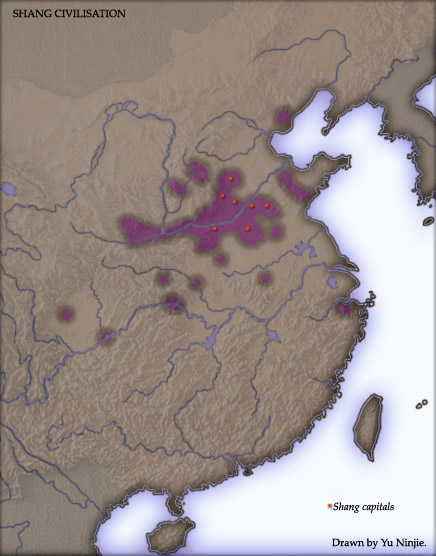
(5) Map of Shang
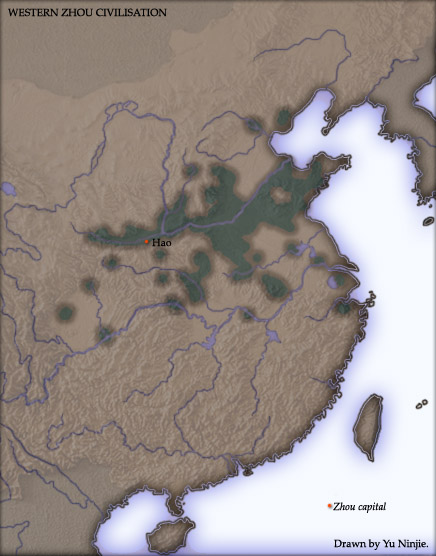
(6) Map of Zhou
Secondary References:
*Treasures from the Bronze Age of China: An Exhibition from the People's Republic of China. New York: Metropolitan Museum of Art, 1980.
*Edward L. Shaughnessy. Sources of Western Zhou History: Inscribed Bronze Vessels. Berkeley: U of California P, 1992.
*Yu
*Yi the archer
Important archealogical discoveries of ritualized bronze vessels beginning in the early Han dynasty (206BC-220AD) posed a material site on which to ground Chinese historical and mythological fantasies. These bronze vessels, once used as ritualized containers of foods and wines, from the Han to the modern era became receptacles for a Chinese imagination of its own origins. They were both the proof of cultural intuitions of greatness and uniqueness and the material, fetishized oracle of re-imaginations of the same. Thus, they were the tangible sign of illustrious civilization and the material mandate for future, cultural consolidation and diffusion. A grotesque, but nonetheless telling, example of how the bronze vessel was used to benefit later generations comes at the end of the Southern Song dynasty (960-1127AD). Faced with the invasion of Jurchen tribes and imminent evacuation to the South, the Song court issued a number of imperial edicts requiring the melting down of bronze vessels into coinage--a literal monetization of what had to that point been only commercable, cultural capital. While this act appears to betray the hallowed significance that the bronze vessel seemed to promise to most eras, it actually reveals the true nature of the power relationship between history and the present, by which the past is ultimately at the mercy of current exigensies and interpretations.
Questions:
(1) What initial, social function do you see these mythologies serving? What might they explain?
(2) What are some scenarios in which you imagine these mythologies being invoked?
(3) Why are material discoveries (i.e. bronze vessels) so important to the formation of identity in the present?
(4) Why were bronze vessels important in the first place? (Shaughnessy 175-83)
Maps and links:
(1) The Met's introduction to Shang and Zhou bronzes
(2) The Piece-mold Method

(3) Chinese Discovery Channel Intro. to Bronze Vessels
(4) The Dynasties
(5) Map of Shang
(6) Map of Zhou
Secondary References:
*Treasures from the Bronze Age of China: An Exhibition from the People's Republic of China. New York: Metropolitan Museum of Art, 1980.
*Edward L. Shaughnessy. Sources of Western Zhou History: Inscribed Bronze Vessels. Berkeley: U of California P, 1992.
Sunday, May 17, 2009
What does it mean to study "Chineseness'?
In the postscript to her chapter “Against the Lures of Diaspora,” Brown University Professor and leading Chinese scholar Rey Chow summarizes the complexities and pitfalls of speaking of and for China from the space of the First World. She explains:
"What are we doing talking about modern Chinese literature and Chinese women in the North American academy in the 1990s? As such activities of speaking and writing are tied less to the oppressed women in Chinese communities in China than to our own intellectual careers in the West, we need to unmask ourselves through a scrupulous declaration of self-interest. Such declaration does not clean our hands, but it prevents the continuance of a tendency, rather strong among Third World intellectual in diaspora as well as researchers of non-Western cultures in First World nations, to sentimentalize precisely those day-to-day realities from which they are distanced." (41)
Chow’s question and its implications are primarily directed at the diaspora of Chinese intellectuals who now find themselves abroad enjoying particularly advantageous positions (conceptually and professionally) from which to give voice to their homelands which have been treated historically as global afterthoughts, minor literatures and cultures. The situation in which we find ourselves is slightly different. Nonetheless, the need to “unmask ourselves” and scrupulously confess our “self-interests” and monitor our sentimentalization of the Chinese Other is no less crucial to the tasks we pose for ourselves in this course.
The social, cultural and linguistic distances that separate us from the Chinese objects of our study is an immense expanse of creative space created by our privilege as so-called First World investigators. However, it is important to realize that this position while it carries with it in name and truth real power, is ultimately delusional as an imagined, exalted height. In other words, the privileged space we occupy is largely an outgrowth of our own ignorance and lack of experience with Chinese languages and cultures. Thus, it behooves us as we study throughout the semester to remind ourselves constantly that our desires, interests, opinions and readings of the history and arts of China are not only underwritten by our own American self-interests but more importantly our fundamental ignorance of our subject. The embrace of this realization will help us to avoid trivializing, essentializing and sentimentalizing Chinese culture as we diligently study and formulate our own critical positions.
Questions:
(1) What are some of your assumptions about what it means to be Chinese?
(2) What are your motives in seeking to define the image of Chineseness?
(3) What are some of our assumptions in feeling empowered, entitled to study this subject?
Introductory Video Clips:
(1) SpongeBob in China
(2) Tom Carter's Portrait of a People
Secondary texts:
*Gayatri Spivak. "Can the Subaltern Speak?" Marxism and the Interpretation of Culture. Ed. Cary Nelson and Lawrence Grossberg. Urbana, IL: University of Illinois Press, 1988. 271-313. (esp. 275)
*Xiaomei Chen, "Introduction," Occidentalism (New York: Oxford UP, 1995), 17.
"What are we doing talking about modern Chinese literature and Chinese women in the North American academy in the 1990s? As such activities of speaking and writing are tied less to the oppressed women in Chinese communities in China than to our own intellectual careers in the West, we need to unmask ourselves through a scrupulous declaration of self-interest. Such declaration does not clean our hands, but it prevents the continuance of a tendency, rather strong among Third World intellectual in diaspora as well as researchers of non-Western cultures in First World nations, to sentimentalize precisely those day-to-day realities from which they are distanced." (41)
Chow’s question and its implications are primarily directed at the diaspora of Chinese intellectuals who now find themselves abroad enjoying particularly advantageous positions (conceptually and professionally) from which to give voice to their homelands which have been treated historically as global afterthoughts, minor literatures and cultures. The situation in which we find ourselves is slightly different. Nonetheless, the need to “unmask ourselves” and scrupulously confess our “self-interests” and monitor our sentimentalization of the Chinese Other is no less crucial to the tasks we pose for ourselves in this course.
The social, cultural and linguistic distances that separate us from the Chinese objects of our study is an immense expanse of creative space created by our privilege as so-called First World investigators. However, it is important to realize that this position while it carries with it in name and truth real power, is ultimately delusional as an imagined, exalted height. In other words, the privileged space we occupy is largely an outgrowth of our own ignorance and lack of experience with Chinese languages and cultures. Thus, it behooves us as we study throughout the semester to remind ourselves constantly that our desires, interests, opinions and readings of the history and arts of China are not only underwritten by our own American self-interests but more importantly our fundamental ignorance of our subject. The embrace of this realization will help us to avoid trivializing, essentializing and sentimentalizing Chinese culture as we diligently study and formulate our own critical positions.
Questions:
(1) What are some of your assumptions about what it means to be Chinese?
(2) What are your motives in seeking to define the image of Chineseness?
(3) What are some of our assumptions in feeling empowered, entitled to study this subject?
Introductory Video Clips:
(1) SpongeBob in China
(2) Tom Carter's Portrait of a People
Secondary texts:
*Gayatri Spivak. "Can the Subaltern Speak?" Marxism and the Interpretation of Culture. Ed. Cary Nelson and Lawrence Grossberg. Urbana, IL: University of Illinois Press, 1988. 271-313. (esp. 275)
*Xiaomei Chen, "Introduction," Occidentalism (New York: Oxford UP, 1995), 17.
Subscribe to:
Posts (Atom)