Under the ambitious direction of Emperor Wu, the Han dynasty (202BC-220AD) successfully moved forward in the kind of empire making the tyrant Qin Shi Huang had begun decades before. Emperor Wu pushed the borders of his kingdom into the vast frontiers of other foreign lands. His troops reached the lands of central Asia, northern Korea and northern Vietnam, beating back barbarians (Xiongnu) and forging new trade and diplomatic routes. Back in the heart of his kingdom, Emperor Wu established the parameters of a new cultural order as well. Confucianism, only one of many philosophies and orders introduced and developed during the Eastern Zhou, now became the ruling doctrine of the court and the ethical paradigm for Han society.
In the midst of these monumental imperial achievements, Emperor Wu made sure that his court historians and recorders were on hand to document the events and weave them into the grand historical narratives of Chinese civilization. The Sima family (司馬) was intimately involved in the production of a new comprehensive history of China. Sima Tan held the position of Grand Historian at court for thirty years (140-110BC) before his health failed him and he was forced to cede the position to his prodigious son, Sima Qian. Sima Qian picked up where his father left off, gathering sources and completing the Records of the Grand Historian (史記). Because of his unique and turbulent history and numerous literary gifts, Sima Qian's historical record would refashion the face of Chinese historiography and set a standard for prose compositions for millenia to come. Unlike the strictly dynastic histories of the past, Sima Qian's volumes span thousands of years of history and highlight the lives of important figures in a string of exempla. His project is ambitious as a sort of universal history that transcends its own particular moment in time. However, at the same time it demonstrates a sensitivity to details and character that attests to its author's consciousness of specific conditions and human natures.
Readings:
Emperor Wu of the Han (see ANGEL)
Qu Yuan (see ANGEL)
Jingke, Assassin
Questions:
(1) How does Sima Qian characterize the Zhou?
(2) How does Emperor of Wu, Sima Qian's contemporary, come off in this biography?
(3) How does the biography of Jingke from the exemplary persons section of the records differ from the previous accounts?
(4) What is your opinion of what Sima Qian understands to be the universal history of the Chinese?
Links:
(1) Han Map
Secondary references:
Saturday, May 23, 2009


Friday, May 22, 2009
Confucian Cortegiani and Fluttering Sages
After the fall of the Ji family at the end of the Western Zhou, the Zhou clan began its steady descent from the heights of real power into the trappings of nominal rule. The centuries following, called the Eastern Zhou, were marked by a steady growth in the increasing power of smaller principates and kingdoms once held under the centralized power of the early Zhou. 12 powerful rulers (十二諸侯) directed the most important affairs of the continent. As the years wore on, the Zhou clan receded from the forefront of power as military mights such Qin, Jin, Qi, Chu and Wu rose to prominence. These states thrived off of the consumption of smaller neighboring states and the volatile dealings of foreign diplomacy between one another. With the Zhou remaining merely as a puppet suzerain, the infighting between the these powerful states threw society into centuries of unrest. The chaotic conditions of life, however, created the conditions under which innovation was possible. It was toward the end of the Spring and Autumn period (722-481BC) and the beginning of the Warring States period (476-221BC) that Kongzi or Confucius was born and would initiate a cultural revolution that would shape China for millenia to come.
Confucius was part of a new emerging class of minor, poor nobility (士) who were involved in the active formulation of new cultural paradigms for China and who peddled their intellect and virtue as a means for their own physical and existential sustenance. Amidst the turmoil of these times, men of superior intellect wandered from court to court seeking audience and offering their services to (mostly corrupt) officials. Though he would become the most well known, Confucius was hardly the only important figure of this intellectually vibrant period. In fact, the period is also known today as that of the 100 schools of philosophy (諸子百傢). Alongside Confucius, equally important figures in their times were Mozi, Laozi, Han Feizi, Zhuangzi and Mencius. Each of these figures would present their own versions of what constituted a harmonious society and an ideal rulership. Each philosophized their own way (道) of personal and communal cultivation to the establishment of harmony and order, that eagerly sought after point of natural repose. In our readings we look behind the philosophy to the role of the philosopher in the pitching of the way to the achievement of repose. We will read excerpts from the Analects (Confucius), the Mencius, Mozi, the Laozi and the Zhuangzi as we seek to formulate how the role of the philosopher evolves and effects and is effected by his philosophies of social and inner harmony.
Readings:
Analects (Book 1 and 2)
Mencius (Book 1.1)
Mozi (Book 4.1 and 5.1,2)
Laozi (Ch. 29-39)
Zhuangzi (Ch. 7)
Questions:
(1) How would you characterize the character or tones of these different philosophers?
(2) What are some of the details of their way or dao (道)?
(3) How are these philosophers implicated in their own philosophies or in the societies they hope to establish?
Links:
(1) Slides for 100 Schools
Secondary readings:
Confucius was part of a new emerging class of minor, poor nobility (士) who were involved in the active formulation of new cultural paradigms for China and who peddled their intellect and virtue as a means for their own physical and existential sustenance. Amidst the turmoil of these times, men of superior intellect wandered from court to court seeking audience and offering their services to (mostly corrupt) officials. Though he would become the most well known, Confucius was hardly the only important figure of this intellectually vibrant period. In fact, the period is also known today as that of the 100 schools of philosophy (諸子百傢). Alongside Confucius, equally important figures in their times were Mozi, Laozi, Han Feizi, Zhuangzi and Mencius. Each of these figures would present their own versions of what constituted a harmonious society and an ideal rulership. Each philosophized their own way (道) of personal and communal cultivation to the establishment of harmony and order, that eagerly sought after point of natural repose. In our readings we look behind the philosophy to the role of the philosopher in the pitching of the way to the achievement of repose. We will read excerpts from the Analects (Confucius), the Mencius, Mozi, the Laozi and the Zhuangzi as we seek to formulate how the role of the philosopher evolves and effects and is effected by his philosophies of social and inner harmony.
Readings:
Analects (Book 1 and 2)
Mencius (Book 1.1)
Mozi (Book 4.1 and 5.1,2)
Laozi (Ch. 29-39)
Zhuangzi (Ch. 7)
Questions:
(1) How would you characterize the character or tones of these different philosophers?
(2) What are some of the details of their way or dao (道)?
(3) How are these philosophers implicated in their own philosophies or in the societies they hope to establish?
Links:
(1) Slides for 100 Schools
Secondary readings:
Monday, May 18, 2009
Brazen Kings and Bronze Vessels
China, like any venerable, classical civilization, has woven its own web of mythological foundations. As anthropologists and psychoanalysts of the 19th and 20th centuries have insisted, understanding the mysterious and fantastical foundations of civilization is essential to more fully grasping the evolutionary nature of human history. In the case of China, familiarizing ourselves with the legends of great emperors long past and some central, creation myths and aetiologies, allows us to tap into the rich deposits of Chinese historical and imaginary thinking. While avoiding psychoanalyzing these myths (in the way Greek myth is often allegorized) we may miss posing any universal, human substratum to legend that make them transculturally intelligible. However, this avoidance is also an interpretive strategy with its own benefits, by which we hope to attain to a more precise historical nature of the legends and their repeated use throughout a millenial Chinese history. By learning these legends, we immediately become sensitive to the myriad ways in which they are inovked in subsequent texts to specific political ends. Today, we familiarize ourselves with a portion of the quasi-historical or mythological foundations of China that will assist us in understanding later historical moments and discussions in which they arise:
*Yu
*Yi the archer
Important archealogical discoveries of ritualized bronze vessels beginning in the early Han dynasty (206BC-220AD) posed a material site on which to ground Chinese historical and mythological fantasies. These bronze vessels, once used as ritualized containers of foods and wines, from the Han to the modern era became receptacles for a Chinese imagination of its own origins. They were both the proof of cultural intuitions of greatness and uniqueness and the material, fetishized oracle of re-imaginations of the same. Thus, they were the tangible sign of illustrious civilization and the material mandate for future, cultural consolidation and diffusion. A grotesque, but nonetheless telling, example of how the bronze vessel was used to benefit later generations comes at the end of the Southern Song dynasty (960-1127AD). Faced with the invasion of Jurchen tribes and imminent evacuation to the South, the Song court issued a number of imperial edicts requiring the melting down of bronze vessels into coinage--a literal monetization of what had to that point been only commercable, cultural capital. While this act appears to betray the hallowed significance that the bronze vessel seemed to promise to most eras, it actually reveals the true nature of the power relationship between history and the present, by which the past is ultimately at the mercy of current exigensies and interpretations.
Questions:
(1) What initial, social function do you see these mythologies serving? What might they explain?
(2) What are some scenarios in which you imagine these mythologies being invoked?
(3) Why are material discoveries (i.e. bronze vessels) so important to the formation of identity in the present?
(4) Why were bronze vessels important in the first place? (Shaughnessy 175-83)
Maps and links:
(1) The Met's introduction to Shang and Zhou bronzes
(2) The Piece-mold Method
(3) Chinese Discovery Channel Intro. to Bronze Vessels
(4) The Dynasties
(5) Map of Shang
(6) Map of Zhou
Secondary References:
*Treasures from the Bronze Age of China: An Exhibition from the People's Republic of China. New York: Metropolitan Museum of Art, 1980.
*Edward L. Shaughnessy. Sources of Western Zhou History: Inscribed Bronze Vessels. Berkeley: U of California P, 1992.
*Yu
*Yi the archer
Important archealogical discoveries of ritualized bronze vessels beginning in the early Han dynasty (206BC-220AD) posed a material site on which to ground Chinese historical and mythological fantasies. These bronze vessels, once used as ritualized containers of foods and wines, from the Han to the modern era became receptacles for a Chinese imagination of its own origins. They were both the proof of cultural intuitions of greatness and uniqueness and the material, fetishized oracle of re-imaginations of the same. Thus, they were the tangible sign of illustrious civilization and the material mandate for future, cultural consolidation and diffusion. A grotesque, but nonetheless telling, example of how the bronze vessel was used to benefit later generations comes at the end of the Southern Song dynasty (960-1127AD). Faced with the invasion of Jurchen tribes and imminent evacuation to the South, the Song court issued a number of imperial edicts requiring the melting down of bronze vessels into coinage--a literal monetization of what had to that point been only commercable, cultural capital. While this act appears to betray the hallowed significance that the bronze vessel seemed to promise to most eras, it actually reveals the true nature of the power relationship between history and the present, by which the past is ultimately at the mercy of current exigensies and interpretations.
Questions:
(1) What initial, social function do you see these mythologies serving? What might they explain?
(2) What are some scenarios in which you imagine these mythologies being invoked?
(3) Why are material discoveries (i.e. bronze vessels) so important to the formation of identity in the present?
(4) Why were bronze vessels important in the first place? (Shaughnessy 175-83)
Maps and links:
(1) The Met's introduction to Shang and Zhou bronzes
(2) The Piece-mold Method

(3) Chinese Discovery Channel Intro. to Bronze Vessels
(4) The Dynasties
(5) Map of Shang
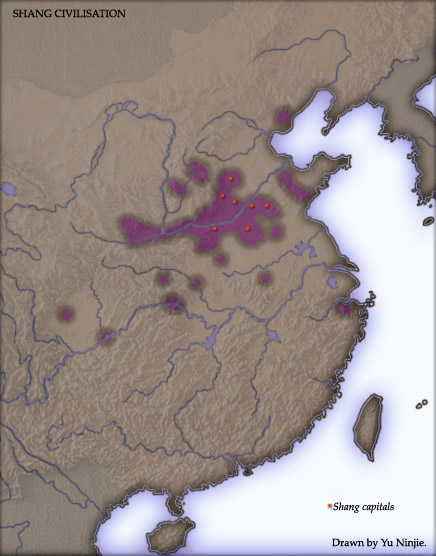
(6) Map of Zhou
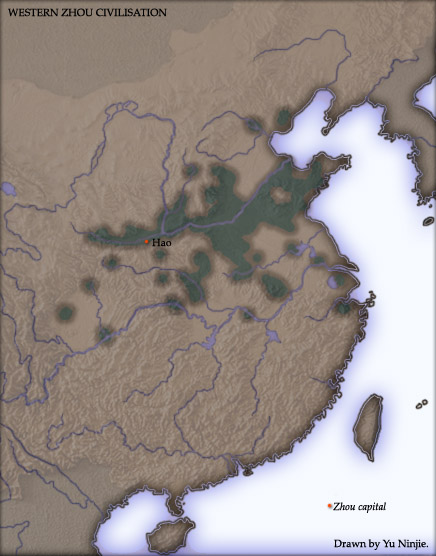
Secondary References:
*Treasures from the Bronze Age of China: An Exhibition from the People's Republic of China. New York: Metropolitan Museum of Art, 1980.
*Edward L. Shaughnessy. Sources of Western Zhou History: Inscribed Bronze Vessels. Berkeley: U of California P, 1992.
Sunday, May 17, 2009
What does it mean to study "Chineseness'?
In the postscript to her chapter “Against the Lures of Diaspora,” Brown University Professor and leading Chinese scholar Rey Chow summarizes the complexities and pitfalls of speaking of and for China from the space of the First World. She explains:
"What are we doing talking about modern Chinese literature and Chinese women in the North American academy in the 1990s? As such activities of speaking and writing are tied less to the oppressed women in Chinese communities in China than to our own intellectual careers in the West, we need to unmask ourselves through a scrupulous declaration of self-interest. Such declaration does not clean our hands, but it prevents the continuance of a tendency, rather strong among Third World intellectual in diaspora as well as researchers of non-Western cultures in First World nations, to sentimentalize precisely those day-to-day realities from which they are distanced." (41)
Chow’s question and its implications are primarily directed at the diaspora of Chinese intellectuals who now find themselves abroad enjoying particularly advantageous positions (conceptually and professionally) from which to give voice to their homelands which have been treated historically as global afterthoughts, minor literatures and cultures. The situation in which we find ourselves is slightly different. Nonetheless, the need to “unmask ourselves” and scrupulously confess our “self-interests” and monitor our sentimentalization of the Chinese Other is no less crucial to the tasks we pose for ourselves in this course.
The social, cultural and linguistic distances that separate us from the Chinese objects of our study is an immense expanse of creative space created by our privilege as so-called First World investigators. However, it is important to realize that this position while it carries with it in name and truth real power, is ultimately delusional as an imagined, exalted height. In other words, the privileged space we occupy is largely an outgrowth of our own ignorance and lack of experience with Chinese languages and cultures. Thus, it behooves us as we study throughout the semester to remind ourselves constantly that our desires, interests, opinions and readings of the history and arts of China are not only underwritten by our own American self-interests but more importantly our fundamental ignorance of our subject. The embrace of this realization will help us to avoid trivializing, essentializing and sentimentalizing Chinese culture as we diligently study and formulate our own critical positions.
Questions:
(1) What are some of your assumptions about what it means to be Chinese?
(2) What are your motives in seeking to define the image of Chineseness?
(3) What are some of our assumptions in feeling empowered, entitled to study this subject?
Introductory Video Clips:
(1) SpongeBob in China
(2) Tom Carter's Portrait of a People
Secondary texts:
*Gayatri Spivak. "Can the Subaltern Speak?" Marxism and the Interpretation of Culture. Ed. Cary Nelson and Lawrence Grossberg. Urbana, IL: University of Illinois Press, 1988. 271-313. (esp. 275)
*Xiaomei Chen, "Introduction," Occidentalism (New York: Oxford UP, 1995), 17.
"What are we doing talking about modern Chinese literature and Chinese women in the North American academy in the 1990s? As such activities of speaking and writing are tied less to the oppressed women in Chinese communities in China than to our own intellectual careers in the West, we need to unmask ourselves through a scrupulous declaration of self-interest. Such declaration does not clean our hands, but it prevents the continuance of a tendency, rather strong among Third World intellectual in diaspora as well as researchers of non-Western cultures in First World nations, to sentimentalize precisely those day-to-day realities from which they are distanced." (41)
Chow’s question and its implications are primarily directed at the diaspora of Chinese intellectuals who now find themselves abroad enjoying particularly advantageous positions (conceptually and professionally) from which to give voice to their homelands which have been treated historically as global afterthoughts, minor literatures and cultures. The situation in which we find ourselves is slightly different. Nonetheless, the need to “unmask ourselves” and scrupulously confess our “self-interests” and monitor our sentimentalization of the Chinese Other is no less crucial to the tasks we pose for ourselves in this course.
The social, cultural and linguistic distances that separate us from the Chinese objects of our study is an immense expanse of creative space created by our privilege as so-called First World investigators. However, it is important to realize that this position while it carries with it in name and truth real power, is ultimately delusional as an imagined, exalted height. In other words, the privileged space we occupy is largely an outgrowth of our own ignorance and lack of experience with Chinese languages and cultures. Thus, it behooves us as we study throughout the semester to remind ourselves constantly that our desires, interests, opinions and readings of the history and arts of China are not only underwritten by our own American self-interests but more importantly our fundamental ignorance of our subject. The embrace of this realization will help us to avoid trivializing, essentializing and sentimentalizing Chinese culture as we diligently study and formulate our own critical positions.
Questions:
(1) What are some of your assumptions about what it means to be Chinese?
(2) What are your motives in seeking to define the image of Chineseness?
(3) What are some of our assumptions in feeling empowered, entitled to study this subject?
Introductory Video Clips:
(1) SpongeBob in China
(2) Tom Carter's Portrait of a People
Secondary texts:
*Gayatri Spivak. "Can the Subaltern Speak?" Marxism and the Interpretation of Culture. Ed. Cary Nelson and Lawrence Grossberg. Urbana, IL: University of Illinois Press, 1988. 271-313. (esp. 275)
*Xiaomei Chen, "Introduction," Occidentalism (New York: Oxford UP, 1995), 17.
Sunday, May 3, 2009
Words to Live By
The Four Books of Confucianism was a collection designated by Song dynasty intellectual Zhu Xi as the foundation of Confucianism and the basis for the civil service examinations. It contained the words of Confucius and his closest disciples (and later commentators), including his famed successor Mencius. The Four Books include: The Great Learning, The Golden Mean, The Analects and The Mencius.
The first two are actually chapters from the classical text, The Book of Rites, purportedly written by Confucius himself. The Great Learning and The Golden Mean place learning, virtue, and self-cultivation well within the scope of the interests of society and the pursuit of ideas of dialectical and social harmony. In a sense, unlike a radical Grecian or Christian truth that promises to destabilize society, a Confucian truth tends to harmonize all facets of personal and collective existence. The last two books, The Analects and The Mencius, are the Chinese equivalents of Platonic dialogues in which the master Confucius and his disciples (principally Mencius) are shown conversing with important political leaders and their own followers in which they convey proper behavioral and ethical codes. These books were the cornerstones of learning, ethics and courtesy in China for millenia. Their wisdom and stories are part of the Chinese collective memory and still on the tip of many tongues.
Readings:
The Great Learning
The Golden Mean
The Analects
The Mencius
Questions:
(1) Find evidences where personal cultivation and social harmony meet.
(2) How do you negotiate the dynamic between the wisdom of tradition and the virtue brought to bear by the individual?
(3) What does a web of learning look like? And what is meant by man's resting place within it?
(4) What are the attributes of a learned, virtuous man as defined by these texts?
Links:
(1) The Classic of Poetry as the anchor of Confucianism (LiJi 29)
Secondary readings:
*Wing-Tsit Chan. "Neo-Confucianism: New Ideas on Old Terminology" Philosophy East and West vol.17, no. 1/4 (1967): 15-35.
The first two are actually chapters from the classical text, The Book of Rites, purportedly written by Confucius himself. The Great Learning and The Golden Mean place learning, virtue, and self-cultivation well within the scope of the interests of society and the pursuit of ideas of dialectical and social harmony. In a sense, unlike a radical Grecian or Christian truth that promises to destabilize society, a Confucian truth tends to harmonize all facets of personal and collective existence. The last two books, The Analects and The Mencius, are the Chinese equivalents of Platonic dialogues in which the master Confucius and his disciples (principally Mencius) are shown conversing with important political leaders and their own followers in which they convey proper behavioral and ethical codes. These books were the cornerstones of learning, ethics and courtesy in China for millenia. Their wisdom and stories are part of the Chinese collective memory and still on the tip of many tongues.
Readings:
The Great Learning
The Golden Mean
The Analects
The Mencius
Questions:
(1) Find evidences where personal cultivation and social harmony meet.
(2) How do you negotiate the dynamic between the wisdom of tradition and the virtue brought to bear by the individual?
(3) What does a web of learning look like? And what is meant by man's resting place within it?
(4) What are the attributes of a learned, virtuous man as defined by these texts?
Links:
(1) The Classic of Poetry as the anchor of Confucianism (LiJi 29)
Secondary readings:
*Wing-Tsit Chan. "Neo-Confucianism: New Ideas on Old Terminology" Philosophy East and West vol.17, no. 1/4 (1967): 15-35.
Saturday, May 2, 2009
Hooking-Up in Antiquity
A dominant trend in Shijing scholarship over the past century has taken a markedly anthropological approach to the interpretation of these some 300 classical, Chinese poems. The collection's poems deal most directly with concerns, activities, rituals and histories intimately connected to the lives of the common folk. Their origins in a pre-literate, oral reality, combined with their later, overtly Confucian overlay, have lead many sinologists to emphasize the social, ritualized significance of the verses. One of the dominant topics of the Shijing, love and courtship, continues to fascinate anthropologists seeking to piece together the habits of the ancient enamored.
Our readings of the Shijing poems (mainly from the opening Guofeng section) will address the potential social functions indicated by the above anthropological method as well as the later Confucian interpretations and allegorizations that solemnized the poems as guides for ethical, proper behavior in civilized, courtly society (v.s. Large and Small prefaces).
Readings:
Odes Of Zhou (1-11)
Odes of Shao (12-25)
Questions:
(1) What is the tone of the various poetic voices in these poems?
(2) What do the poems convey to you about romantic or marital relationships in (pre-) classical China?
(3) How does the fact that the poems were written by men about women's relationships affect our understanding of what is conveyed in the poems?
Links:
(1) Great Preface
(2) Guan-guan
(3) Virginia's dual-language Shijing etext
Secondary references:
* Kern, Martin. "Shijing Songs as Performance Texts: A Case Study of 'Chu ci'." Early China 25 (2000): 49-111.
*Shaugnessy, Edward L. "From Liturgy to Literature: The Ritual Contexts of the Earliest Poems in the Book of Poetry." Before Confucius: Studies in the Creation of the Chinese Classics. Albany: SUNY Press, 1997. 165-197.
* Granet, Marcel. Festivals and Songs of Ancient China. New York: E.P. Dutton & Co., 1975.
Our readings of the Shijing poems (mainly from the opening Guofeng section) will address the potential social functions indicated by the above anthropological method as well as the later Confucian interpretations and allegorizations that solemnized the poems as guides for ethical, proper behavior in civilized, courtly society (v.s. Large and Small prefaces).
Readings:
Odes Of Zhou (1-11)
Odes of Shao (12-25)
Questions:
(1) What is the tone of the various poetic voices in these poems?
(2) What do the poems convey to you about romantic or marital relationships in (pre-) classical China?
(3) How does the fact that the poems were written by men about women's relationships affect our understanding of what is conveyed in the poems?
Links:
(1) Great Preface
(2) Guan-guan
(3) Virginia's dual-language Shijing etext
Secondary references:
* Kern, Martin. "Shijing Songs as Performance Texts: A Case Study of 'Chu ci'." Early China 25 (2000): 49-111.
*Shaugnessy, Edward L. "From Liturgy to Literature: The Ritual Contexts of the Earliest Poems in the Book of Poetry." Before Confucius: Studies in the Creation of the Chinese Classics. Albany: SUNY Press, 1997. 165-197.
* Granet, Marcel. Festivals and Songs of Ancient China. New York: E.P. Dutton & Co., 1975.
Wednesday, April 8, 2009
Introduction to Chinese Culture, Cinema and Literature
 Welcome to CHNS260. This course will be fast and furious and with your participation, maddeningly entertaining. I've posted the syllabus for your perusal and am confident you'll find a number of topics that will both interest and befuddle you. The idea of the course is to introduce familiar, stimulating and controversial topics on China on a daily basis in a salon-like format. Daily readings are the foundations for open, lively discussion on a given topic for that day. Your informed, intelligent opinions (and occasional rants) are urgently solicited. I look forward to meeting and hearing from you all soon.
COURSE DESCRIPTION
Informed by cutting-edge approaches to the study of China, this multimedia-enhanced course introduces students to classical and modern Chinese literature, culture and cinema. Topics integral to the history and perception of China guide daily discussion and include: kungfu, nationalism, hiphop, buddhism, basketball, gender, sexuality, insanity, the rickshaw, etc. As students deepen their understanding of the historical significance of these topics they will continuously be challenged to formulate what it means to be Chinese and to interrogate how and why they define it in such ways.
COURSE OBJECTIVES
(1) To increase specific and general knowledge of China’s artistic and cultural history;
(2) To enhance skills to analyze the different artistic genres and cultural phenomena of the Chinese-speaking world;
(3) To learn to produce different kinds of evaluative literature of the arts: (a) collegiate essay, (b) film review, (c) book review, (d) presentation(s);
(4) To develop appropriate, professional communication skills through writing assignments, class discussion and presentations.
TEXTS
To save you money most of the primary readings are made available online (as PDF files or HTML files) through the course websites and library e-Reserves. You need to access the texts well in advance in case there are problems with the websites. There are also two other inexpensive books that you will need to purchase for the course:
(1) Gascoigne, Bamber. The Dynasties of China. London: Constable & Robinson, Ltd., 2003. (~$12)
(2) Berry, Christopher J. and Mary Ann Farquhar. China on Screen: Cinema and Nation. New York: Columbia UP. 2006. (~$20)
TENTATIVE SCHEDULE:
(***The instructor withholds the right to adjust the syllabus at any time.)
Week I : Cultural Foundations
5/18 M Introduction to Course: What does it mean to study “Chineseness”?
5/19 T Bronze Vessels and Brazen Kings (read The Dynasties of China)
5/20 W Hooking-Up in Antiquity (Selections from the Shi Jing)
5/21 Th Words to Live By (Selections from the Great Learning and the Middle Way)
Week II: The Rise of the Intellectual
5/26 M Confucian Cortegiani (Selections from the Analects, the Mengzi, the Laozi and the Zhuangzi)
5/27 T On Fluttering Sages (Selections from the Liezi and the Biography of Transcendents)
5/28 W Heroic Portraits (Selections from Records of the Grand Historian)
*Book Review (The Dynasties of China, ANGEL)
Week III: Life On the Margins
6/2 T How to be a Hermit (Selections from Tao Yuanming, Xie Lingyun, Meng Haoran, Wang Wei)
6/3 W My Zen Teacher is Nuts! (Selections from The Platform Sutra and Recorded Conversations of Zen Master Yi Xuan)
6/4 Th So I Married an Axe Murderer (Selections from Strange Stories from a Chinese Studio and Sketches from the Cottage)
* Presentations (ANGEL)
Week IV: The Art of Governance
6/9 T Presentations
6/10 W Palace Politics (Selections from Story of the Stone)
6/11 Th Monkeys Rule (Selections from Journey to the West)
* Test 2 (Week 4, ANGEL)/* Collegiate Essay (ANGEL)
Week V: Modernity and Liberation
6/16 T Insanity (Selections from Lu Xun’s short stories and essays)
6/17 W “Iron Women and Foxy Ladies” (Selections from Mao’s Red Book, the Historic Liberation of Chinese Women, The White Haired Girl)
6/18 F Selling Punches and Puns: Bruce Lee and Jackie Chan
*Film Review (Raise the Red Lantern)
Week VI: China and the West; a Remix
6/23 F Zhang Yimou and His Girls (Watch Raise the Red Lantern, Media Center)
6/24 M Shakespeare, the Sonnet and China (Watch The Banquet, Media Center)
6/25 W Yao Ming and Olympic Dreams (Selections from People’s Daily)
Final
6/29 M *Test 2 (On China on Screen: Cinema and Nation and what it means to be “Chinese”)
Subscribe to:
Posts (Atom)